What Does “Registered Clinical Counsellor” Actually Mean? How to Choose a Counsellor in BC
Here's something most people don't know until they go looking for therapy: in British Columbia, anyone can call themselves a counsellor. The words “counsellor” and “therapist” aren't protected titles. Someone with a weekend certificate and someone with seven years of university education and hundreds of hours of supervised clinical training can both put “counsellor” on the door, and from the outside, it can be hard to tell the difference.
That matters, because when you're trusting someone with your trauma history, your marriage, your postpartum year, or your kid's anxiety, the training behind the title is not a technicality. As an RN who became a Registered Clinical Counsellor, I've worked on both sides of our healthcare system, and I want to make this easy: here's what the credentials mean, and what to ask anyone before you book.
What is a Registered Clinical Counsellor (RCC)?
Registered Clinical Counsellor (RCC) is a designation of the BC Association of Clinical Counsellors (BCACC), and unlike “counsellor,” it is a protected credential; you can only use it if you've earned it and maintain it. Every RCC has:
Seven years of university education. Let's put real numbers on this, because “master's degree” can sound abstract: that's a four year bachelor's degree, followed by a three year master's degree in clinical counselling or psychotherapy, with required graduate coursework in areas like psychopathology (understanding mental health diagnosis), counselling theory, group and family therapy, research design, and professional ethics.
Hundreds of hours of supervised clinical work before graduating. The master's degree isn't just classroom learning, it includes a supervised practicum of roughly 400 hours of direct clinical work with real clients, under the oversight of experienced clinicians.
Clinical supervision for registration BCACC requires at least 100 hours of clinical supervision, where an experienced clinician reviews their actual work with clients, before granting the designation.
A criminal record check and professional liability insurance.
A code of ethical conduct and standards of practice they are accountable to, with a formal complaints process if something goes wrong. There is a professional body standing behind the work.
Ongoing professional development the education doesn't stop at registration.
Canadian Certified Counsellors (CCC) a designation of the Canadian Counselling and Psychotherapy Association, meet a comparable master's-level standard. When you see RCC or CCC after a counsellor's name, you're looking at years of graduate training, supervised practice, and professional accountability.
How is that different from certificate-level counselling?
To be clear: there are caring, skilled people doing valuable support work with certificate-level training; peer support, life coaching, and community outreach all have a place. The point isn't that one kind of person is better. The point is that these are different levels of preparation for different kinds of work, and you deserve to know which one you're booking.
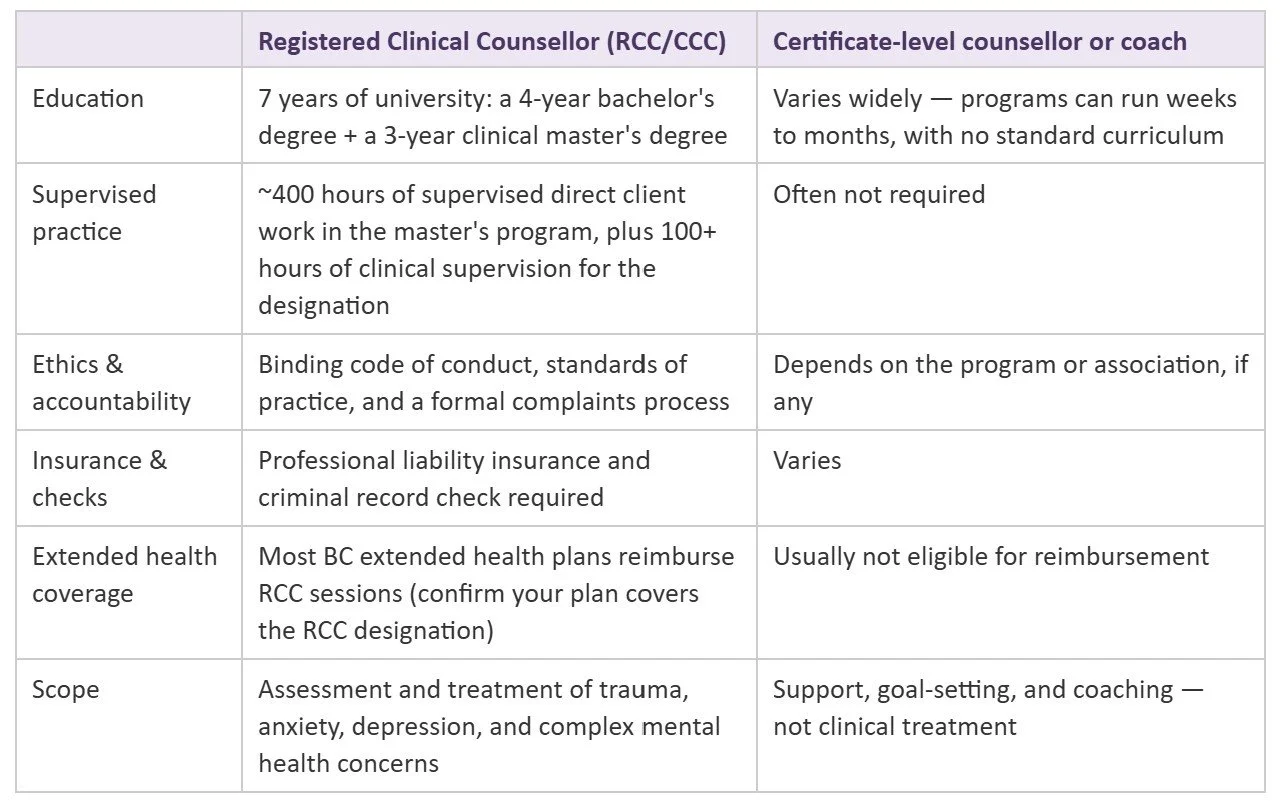
That last row is the heart of it. If what you need is encouragement and accountability toward a goal, a good coach can be a fine fit. If what you're carrying is trauma, chronic anxiety, burnout that's gone past tired, grief, or patterns you've been stuck in for years, that's clinical work, and clinical work calls for clinical training.
Why does the difference matter when you're choosing a therapist?
Because deeper work requires deeper training. Approaches like EMDR, trauma focused therapy, and structured modalities like CBT aren't techniques you pick up in a weekend, they sit on top of graduate level training in how the mind, memory, and nervous system actually work, and in what to do when a session touches something big. A clinician trained to recognize when you've moved outside your window of tolerance can keep therapy safe and effective. That's the difference between a conversation that feels nice and clinical care that creates lasting change.
Because your benefits probably depend on it. Most extended health plans in BC reimburse sessions with an RCC; sessions with an unregistered counsellor or coach usually don't qualify. One phone call to your plan provider before your first session can save you real money.
Because accountability protects you. When your counsellor answers to a professional body, you have somewhere to turn if care falls short. That structure exists for your protection, and it's one of the quietest but most important things the designation buys you.
The standard we hold at Amethyst Therapy
Our practice was built on this distinction. Every counsellor at Amethyst Therapy is registered at the master's level, RCC or CCC, which means every person who sits across from you (in our Williams Lake offices or virtually anywhere in BC) brings seven years of university education, hundreds of hours of supervised clinical training, and professional accountability to the room. And the education was just the starting line: our counsellors bring years of clinical experience beyond their master's degrees, across community mental health, healthcare, and private practice.
And we've gone a step further: we've built a team of clinicians with in-depth specialties, because “I see everyone for everything” is not how excellent care works. Within our team you'll find focused expertise in trauma therapy and EMDR, postpartum mental health, grief, burnout and high functioning anxiety, neurodivergence across teens and adults, and affirming care for 2SLGBTQIA+ clients. When you reach out, we match you to the counsellor whose training actually fits what you're bringing, and our counsellors keep training, consulting, and learning, because clinical excellence isn't a finish line.
I'll say it plainly: you are not a generic client, and you shouldn't settle for generic care.
Questions to ask any counsellor before you book
Whoever you're considering, us or anyone else, you have every right to ask:
What is your registration? (Look for RCC, CCC, or another regulated designation, and know that “certified counsellor” from a private program is not the same thing.)
What is your degree, and in what field?
What specific training do you have in what I'm coming in for?
Are your sessions eligible for extended health reimbursement?
What happens if this isn't the right fit?
A well trained counsellor will welcome every one of those questions. If someone bristles at them, that's information too.
Conclusion
Choosing a counsellor is an act of trust, and trust deserves evidence. The letters after a counsellor's name are shorthand for years of education, supervised practice, and accountability, the foundation that deeper healing is built on.
If you're ready to work with a registered clinical team with genuine specialties, in person in Williams Lake or virtually across BC, we'd be glad to help you find the right fit. Reach out through our booking page, or join our newsletter for honest, evidence based mental health education twice a month.